DATE
June 8, 2026
Category
Ethics
Reading time
5 min
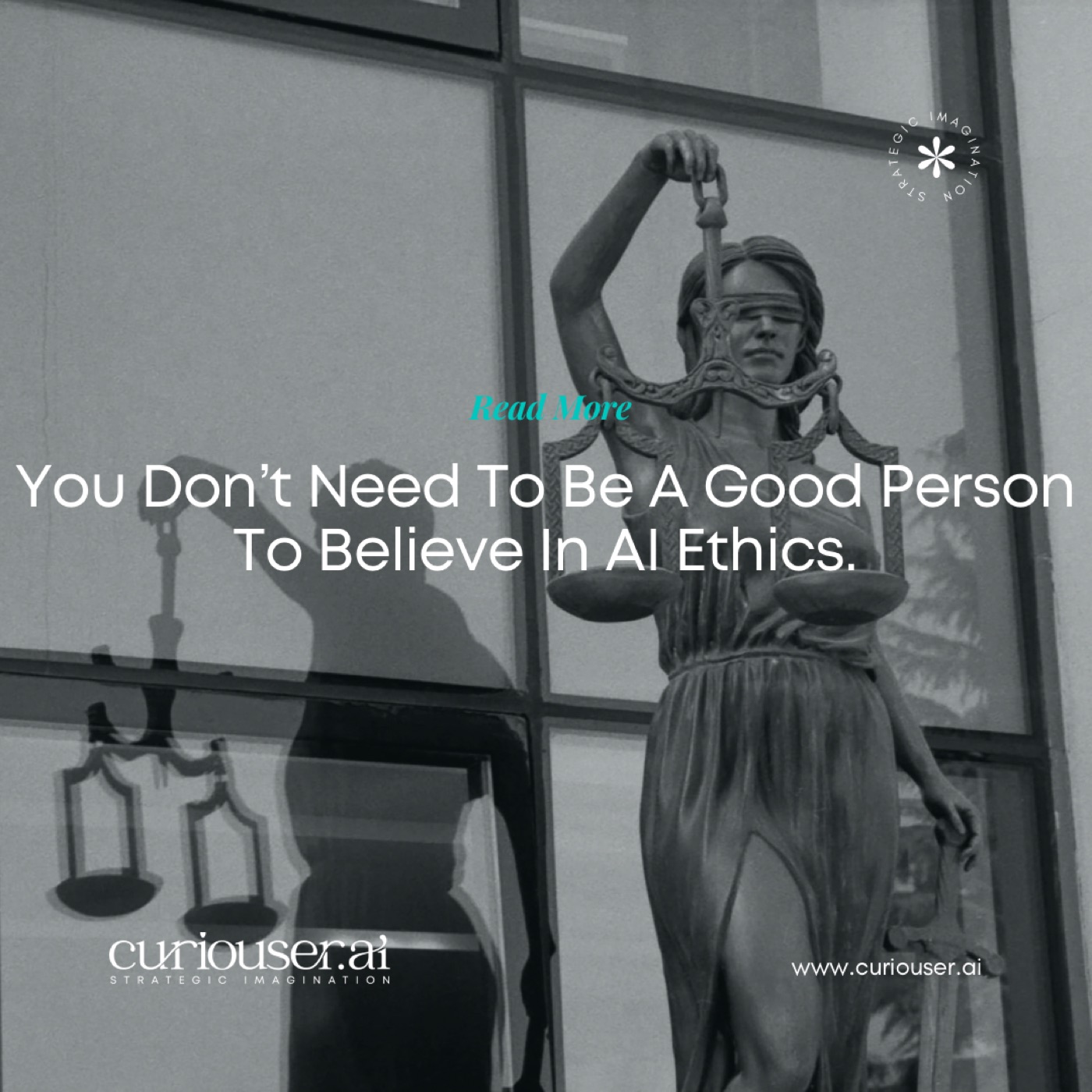
You Don't Need To Be A Good Person To Believe In AI Ethics
Most people still frame AI ethics as a moral conversation.
I increasingly think that framing may be outdated.
Because ethics may be evolving from moral posture into competitive strategy.
That may sound cynical.
It is not intended to be.
It is intended to be practical.
For years, business discussions around ethics often sounded vaguely charitable. Important, perhaps. Noble, certainly. But separate from the real machinery of competition, growth, margins, market share, and survival. A nice thing to care about once the serious work of business had been completed.
That assumption may be breaking down.
Not because humanity suddenly became more enlightened.
Because trust is becoming economically valuable.
In a world increasingly shaped by generative AI, synthetic media, misinformation, algorithmic opacity, regulatory uncertainty, institutional distrust, and infinite digital noise — trust itself may be becoming a strategic asset.
And strategic assets tend to get noticed by highly competitive people.
You do not need to be warm or idealistic to understand this.
You simply have to believe in winning.
Consider what happened recently with Anthropic.
The company took a controversial position around model deployment boundaries and government pressure. Conventional business logic would predict that this type of ethical posture creates drag. Too cautious. Too ideological. Too expensive. Bad for business.
And yet something interesting happened.
In the aftermath of the controversy, Claude surged to the top of Apple's U.S. App Store rankings, overtaking ChatGPT.
Does this prove ethics wins?
Of course not.
But it raises an uncomfortable strategic possibility: ethical differentiation can become market differentiation. Consumers, enterprises, regulators, employees, and investors may increasingly price trust into their decisions. Governance may become brand. Safety may become positioning. Credibility may become product.
That does not make ethics less real.
It makes ethics economically consequential.
If Anthropic is the live experiment, Apple may be the long-term case study.
Apple is far from perfect. But for decades the company operationalized principles that many competitors often dismissed as constraints: privacy, product discipline, customer trust, ecosystem stewardship.
The business outcomes are difficult to ignore. One of the most profitable companies in history. Remarkable customer loyalty. Enormous pricing power. A brand moat that competitors have spent decades attempting to replicate.
Was this morality? Strategy? Both?
Perhaps that is increasingly the wrong question. Because the modern economy may be moving toward a world in which values, trust, governance, and business performance become harder to separate.
Part of the confusion comes from how we talk about ethics.
We often confuse ethics with niceness.
They are not the same thing.
Many ethical leaders are demanding. Competitive. Difficult. Uncompromising. Not particularly warm. Niceness is temperament. Ethics is a framework for decision-making under uncertainty. Those are very different things.
You do not need saints running companies.
You may simply need leaders rational enough to recognize that trust compounds.
This is the possibility many organizations may still be underestimating.
The future of AI ethics may depend less on moral enlightenment — and more on whether markets increasingly reward organizations that operationalize trust.
Because trust influences adoption. Trust affects procurement. Trust shapes regulatory legitimacy. Trust attracts talent. Trust lowers friction. Trust compounds.
For decades, ethics was often framed as restraint. A cost. Compliance. Public relations. Something that sat adjacent to strategy.
That framing may be changing.
Ethics may be evolving from moral posture into competitive strategy.
You do not need to be a good person to notice.
You just have to believe in winning.
Most people still frame AI ethics as a moral conversation. That framing may be outdated. In a world shaped by generative AI, synthetic media, algorithmic opacity, and institutional distrust, trust itself is becoming a strategic asset. Anthropic took a controversial ethical position and Claude surged to the top of the App Store. Apple operationalized privacy and discipline for decades and built one of the most profitable companies in history. Ethics may be evolving from moral posture into competitive strategy. You do not need to be a good person to notice. You just have to believe in winning.
Written by Stephen Klein, Founder/CEO of Curiouser.AI
Stephen Klein is Founder & CEO of Curiouser.AI, a Reflective AI company. He teaches "Marketing in the Age of AI" at UC Berkeley Extension and writes about the intersection of capital, institutions, and technology. His forthcoming book, The Rogue Entrepreneur, is under development with Georgetown University Press. Curiouser.AI is the only AI designed to augment human intelligence. Curiouser is community-funded on WeFunder.

