DATE
June 1, 2026
Category
Strategy
Reading time
8 min
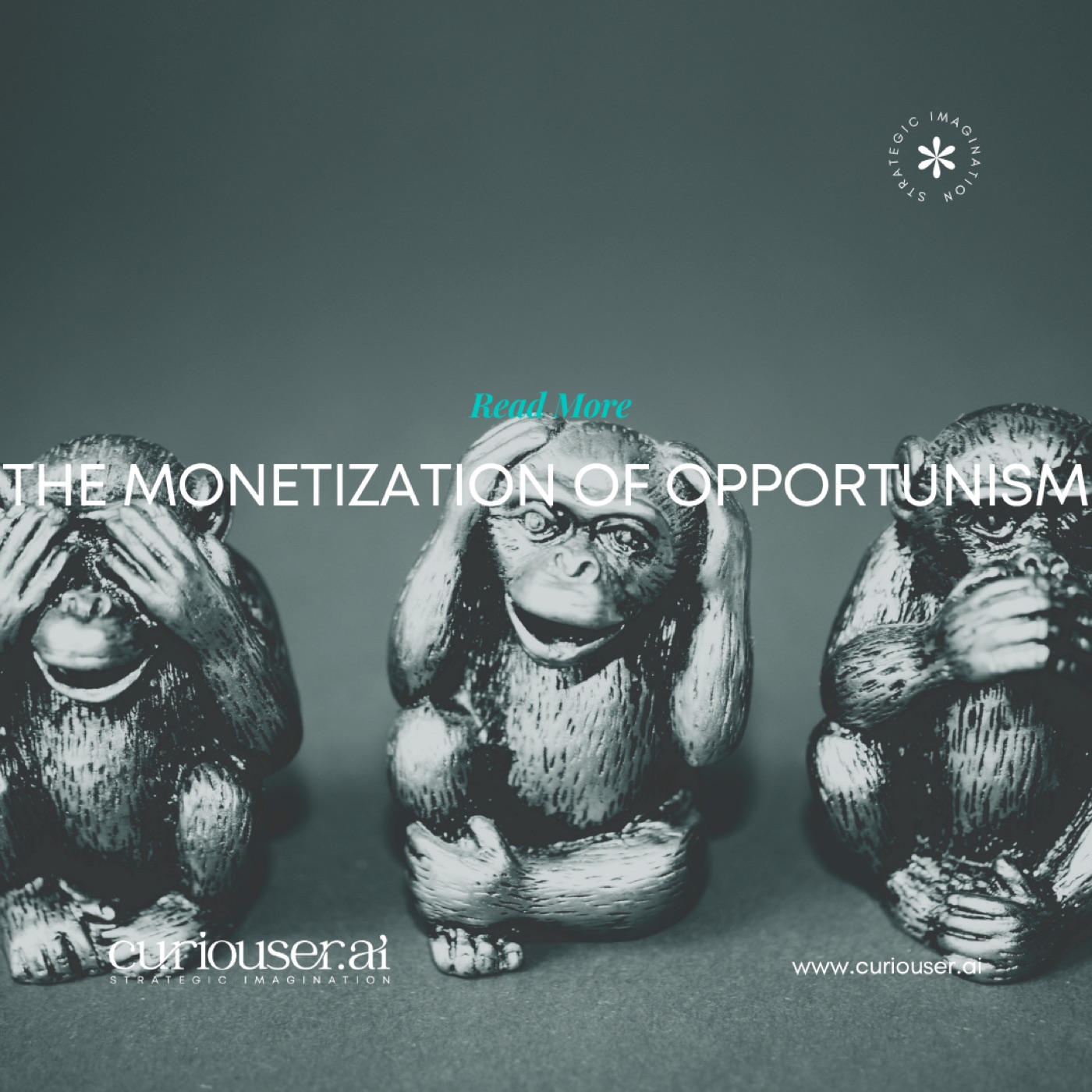
The Monetization of Opportunism

Here is the truth nobody at the top wants to say plainly:
There is no AI job apocalypse. There likely won't be one anytime soon.
The Yale Budget Lab has been tracking this in real time. Their analysis of Bureau of Labor Statistics Current Population Survey data through November and December 2025 found no substantial change in AI's impact on the labor market. In the Lab's own words: "While anxiety over the effects of AI on today's labor market is widespread, our data suggests it remains largely speculative. The picture of AI's impact on the labor market that emerges from our data is one that largely reflects stability, not major disruption at an economy-wide level."
Martha Gimbel, the Lab's executive director and co-founder, put it directly: "No matter which way you look at the data, at this exact moment, it just doesn't seem like there's major macroeconomic effects here."
So why are tech workers being cut by the tens of thousands?
Not because AI made them redundant.
Because their employers are overspending on a wish and a dream, and using payroll as the financing source.
Meta's 2026 capital expenditure guidance: $125 to $145 billion — roughly double its 2025 actual spend of $72 billion. Meta's entire human compensation bill — every salary, every benefit, every stock grant — comes to approximately $27 billion.
The AI infrastructure budget is four to five times the entire payroll.
If Meta fired every employee tomorrow, it would save $27 billion against a $145 billion infrastructure check.
Meta is laying off 8,000 people in May 2026. Another wave is planned for the second half of the year. Free cash flow is projected to collapse from $43.6 billion in 2025 to $8.5 billion in 2026 — an 80% drop as AI capex absorbs operating cash.
Mark Zuckerberg, in a town hall to his own employees, said the quiet part out loud:
"Getting everyone internally to use AI tools and getting to do the work more efficiently is not the thing that's driving layoffs."
He said that. To his own people. The cuts are not productivity-driven. They are financing-driven.
The headcount reductions are paying for the GPUs.
Q1 2026 tech layoffs: 81,747 jobs. The worst quarter since Q1 2024. March alone: 45,800 cuts. A 580% increase from Q4 2025.
In the same window, the Big Four — Microsoft, Amazon, Alphabet, Meta — are committing $725 billion to AI capex in 2026, up 77% year over year.
Amazon: roughly 30,000 layoffs over five months. Q1 2026 capex: $44.2 billion, up 77% year over year. Microsoft: roughly 125,000 voluntary departures. Calendar-year 2026 capex: $190 billion. Alphabet: ongoing reductions. 2026 capex: $175 to $185 billion, nearly double 2025. Meta: 8,000 cuts in May. 2026 capex: $125 to $145 billion — between $315 and $370 million in infrastructure spending. Every single day.
The Big Four hyperscalers are now committing more capital to data centers than ExxonMobil, Chevron, Shell, and BP commit to oil and gas combined.
24/7 Wall St. named it precisely: "Layoffs are not the cost-cutting story here. Layoffs are the financing."
Two years ago these same executives were selling the apocalypse.
Sam Altman, The Atlantic, July 2023: "Jobs are definitely going to go away, full stop."
Altman at the Federal Reserve's Capital Framework for Large Banks conference, July 22, 2025: "Some areas, again, I think just like totally, totally gone." He singled out customer support. He told the room "there are cases where entire classes of jobs will go away."
Altman on X, May 1, 2026: "i think a lot of people are going to be busier (and hopefully more fulfilled) than ever, and jobs doomerism is likely long-term wrong."
Three years. Three positions. The data didn't move him. The Yale Budget Lab numbers haven't changed the underlying story. What changed was the politics. Klarna's CEO walked back his AI rhetoric. Duolingo's Luis von Ahn was eviscerated for declaring "AI-first" and reversed within a week: "I did not expect the amount of blowback."
On the Twenty Minute VC podcast, two software investors summarized the script behind closed doors: "No one is going to get fired. You're just going to do more interesting things. That's the current state of the lie."
Let's say this plainly and unequivocally because we need to know.
The same executives who spent two years telling the public that AI would replace workers — to justify their valuations, to seed the inevitability narrative, to make the buildout look like destiny — are now cutting workers not because AI made them redundant, but because the buildout is so reckless it requires payroll as a financing source.
The worker being shown the door is not being replaced by an algorithm. The worker is being sold to pay for a GPU order whose returns are years away and whose business case is built on a productivity story that, on the data we currently have, is not materializing at scale.
A $145 billion capex line, spread over a 5.5-year server depreciation cycle, means Meta will absorb roughly $26 billion in annual depreciation from these AI assets starting in 2027. The layoff savings offset about 12% of that future depreciation burden.
The math does not work. The story does not match the spreadsheet.
So, they pivot.
They sold the job apocalypse to inflate the valuation. They are cutting jobs to finance the bet. They are walking back the apocalypse now that the politics turned. And the people who lost their jobs are paying for all three positions.
There is no apocalypse. There is a financing problem dressed up as inevitability. There is a class of operators who needed the fear to justify the spend, who needed the spend to justify the story, who needed the story to justify the valuation, and who are now, in the cold morning of 2026, discovering that none of it was real except the harm.
The trick with technology is to avoid spreading darkness at the speed of light.
The darkness here is not the technology. It is the deliberate misrepresentation of what the technology is doing, at the scale of millions of livelihoods, in service of a buildout whose math nobody at the top wants to show the employees being asked to pay for it.
The record is the record.
There is no AI job apocalypse. The Yale Budget Lab found no substantial change in AI's labor market impact through late 2025. What is happening is simpler and worse: the Big Four are committing $725 billion to AI infrastructure in 2026, and they are using payroll to finance it. Mark Zuckerberg told his own employees the quiet part out loud — the layoffs are not productivity-driven, they are financing-driven. The same executives who sold the job apocalypse to inflate their valuations are now walking it back as the politics shift. The people who lost their jobs are paying for all three positions.
Written by Stephen Klein, Founder/CEO of Curiouser.AI
Stephen Klein is Founder & CEO of Curiouser.AI, a Reflective AI company. He teaches "Marketing in the Age of AI" at UC Berkeley Extension and writes about the intersection of capital, institutions, and technology. His forthcoming book, The Rogue Entrepreneur, is under development with Georgetown University Press. Curiouser.AI is the only AI designed to augment human intelligence. Curiouser is community-funded on WeFunder.

