DATE
November 13, 2025
Category
AI
Reading time
6 min
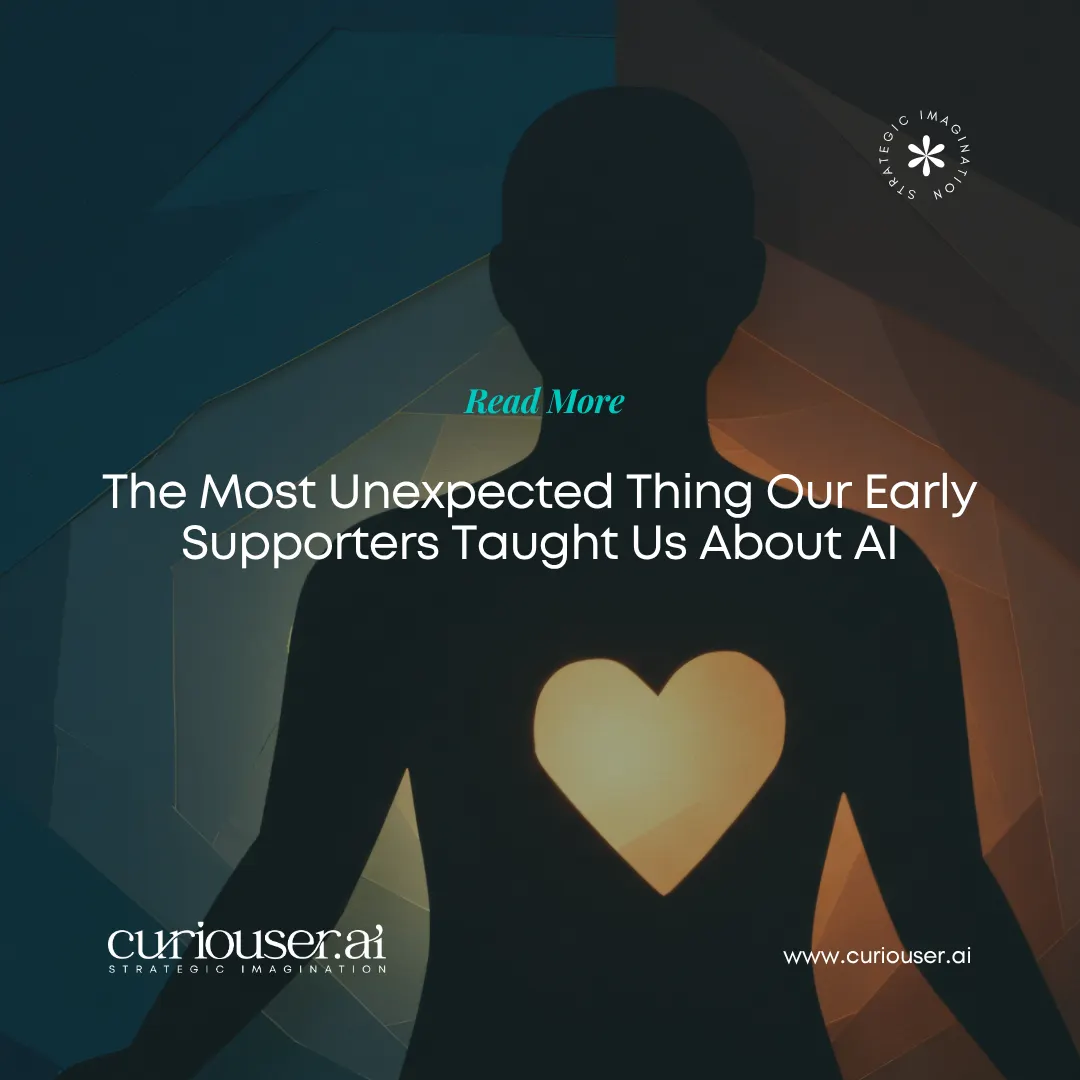
We're Grateful for our Customers and Investors and Here's What Some of them Shared With Us
We didn't expect the messages that came in.
When we opened our WeFunder to early supporters, we thought we knew the range of reactions we might see. Questions about strategy, product direction, business model, differentiation. Curiosity. Skepticism. Maybe a few words of encouragement.
What we didn't expect was what actually arrived.
People didn't just invest. They wrote to us, unprompted, with reflections that were startlingly honest and deeply human. Not surface-level comments about a startup, but confessions about the state of thinking, attention, and the human mind in the age of AI.
It felt less like investor feedback and more like a cross-section of society's subconscious finally surfacing for air.
And for a moment, we wondered if people had simply been waiting for permission to say what they really feel about this era of technology, the excitement, yes, but also the unease… and the quiet fear that we are outsourcing more than tasks. That we may be gradually outsourcing ourselves.
One early supporter, a cybersecurity leader, described his first week using Alice:
"Instead of outsourcing my thinking like I do with ChatGPT and Perplexity, Alice slows me down and asks questions. It frustrates me. But I can feel it rebuilding the mental muscles I lost by abdicating my thinking to AI. Like any instant dopamine hit, it slowly bankrupts me of my mind."
Then he added a line from the Bhagavad Gita:
"What tastes like nectar becomes poison in the end, and what tastes like poison becomes nectar in the end."
If one quote captured the hidden cost of AI "instant answers," that was it.
An IT veteran with 29 years in the field sent a note that felt like a simple moral baseline, one the tech sector has drifted away from:
"AI should augment humanity's capacity, not replace it."
Somewhere along the way, the purpose of technology quietly shifted from elevating human beings to eliminating them from the loop.
What this person wrote wasn't a product opinion. It was a line in the sand.
An educator, someone who has watched generation after generation learn, struggle, imagine, and grow, wrote:
"Real growth comes from asking questions rather than finding quick answers."
Anyone who has ever taught or learned anything meaningful knows this to be true.
Students don't become strong thinkers by being handed conclusions. They grow by wrestling with uncertainty, by staying with the question longer than is comfortable.
Somewhere between convenience, speed, and scale, we forgot that thinking is not a hurdle, it is the pathway.
Then there was a father investing $100 for each of his daughters in STEM, while paying two University of Michigan tuition bills, who wrote:
"I want to invest in an AI tool that integrates empathy, collaboration, and growth."
He wasn't investing in a company.
He was investing in a future he wants his daughters to inherit.
A systems-thinking advisor to enterprise leaders shared something that zoomed the lens out to the structural level, not of tools, but of thinking itself:
"We need to challenge current mental models of how technology should be applied. How we think shapes how we design systems. We need better thinking, and Curiouser AI is setting out to achieve that. I believe they will rise above the flames of the coming crash."
This wasn't commentary on product features.
It was a diagnosis of the intellectual infrastructure behind technology, and a warning about where unexamined assumptions lead.
One engineer and entrepreneur offered a perspective that every innovator instinctively knows:
"I love seeing ideas flipped upside down to reveal new meaning. It's my #1 tool for solving problems, doing the opposite of the conventional answer. It works. Every time."
True innovation rarely comes from following the dominant logic of the moment.
It comes from inversion, from the courage to ask, What if this is backwards?
And then, the one that stayed with us the longest.
A mother and builder wrote:
"I want an AI for my children that is safe, one that won't distort their worldview into dust."
She wasn't talking about harm in the traditional tech sense.
She wasn't asking for guardrails, filters, or safety patches.
She was talking about worldview, the internal landscape through which a human makes meaning.
She was asking for integrity.
None of these people know each other. And none of them know us.
They come from different industries, different worldviews, different generations.
And yet, without coordination, without prompting, they were all saying variations of the same thing, not about us, but about the moment we are living in:
A CISO quoting ancient Hindu philosophy.
A teacher talking about questions.
A software leader confessing AI was dulling the mind.
A systems thinker warning of a coming crash.
A parent protecting the soul of childhood.
All pointing to the same quiet truth:
People are exhausted by AI that thinks for them.
They're craving AI that helps them think.
Not faster answers.
Not more shortcuts.
Not cognitive outsourcing disguised as "productivity."
Something else.
Something more human.
When we started, a lot of people told us we were out of step with the world, that no one would choose an AI that slowed them down to think.
We weren't trying to be contrarian.
We just couldn't shake the belief that thinking wasn't obsolete.
We hoped there were others who still wanted to keep their minds awake.
It turns out… we weren't alone.
What moved us wasn't that people invested.
It was what they invested with, not money, but honesty.
Their words were not about a product. They were about the human condition in a technological age.
About the hunger for reflection.
About the subtle erosion of the inner world.
About a longing to remain awake, not automated.
The comments we received were less like testimonials and more like signals, early indications that something is shifting beneath the surface.
A quiet rebellion, maybe.
A refusal to accept that speed must replace depth, or that convenience must replace consciousness.
A recognition that the ability to think, slowly, independently, originally, is not a flaw to be engineered away.
It is a feature of being alive.
Progress doesn't always mean acceleration.
Some progress looks like reclaiming what we forgot.
Curiosity.
Attention.
Reflection.
Discernment.
Wonder.
Maybe the next era of technology won't be defined by how much it replaces human beings, but by how much it restores in us.
Not frictionless efficiency, but intentional thought.
Not automation of the mind, but expansion of it.
Not escape from ourselves, but a return to ourselves.
There is still a long road ahead, and nothing is guaranteed.
But these early reflections, from people with no coordination and no shared script, gave us something we didn't realize we needed.
Not validation.
Hope.
Hope that more people feel this quiet discomfort with the direction of AI.
Hope that a different path is not only possible, but desired.
Hope that we have not forgotten the value of the interior world.
Some things are worth protecting.
This feels like one of them.
"The trick with technology is to avoid spreading darkness at the speed of light."
Curiouser.AI is backed by a growing community of believers who share a simple conviction: the next era of AI must elevate people, not diminish them.
$400,000 raised in total. 40+ investors. 60% product paid conversion
If this resonates visit WeFunder.
When we opened our WeFunder, we expected questions and maybe some encouragement. What we received were honest reflections about the state of thinking, attention, and the human mind in the age of AI. From a CISO quoting ancient philosophy to a mother protecting her children's worldview, these messages revealed a quiet truth: people are exhausted by AI that thinks for them. They're craving AI that helps them think. We hoped we weren't alone in believing that thinking wasn't obsolete. It turns out… we weren't.
Written by Stephen B. Klein

