DATE
December 11, 2025
Category
AI
Reading time
3 min
This May Be One Of Those Times In Human History

We are watching the fastest acceleration of automation in history collide with something much quieter and harder to talk about — a crisis of creativity, judgment, attention, and meaning.
The dominant narrative says the goal of AI is replacement.
Replace human labor. Replace human thinking. Replace human decision-making.
That narrative is being presented as inevitable, as progress itself.
But inevitability is not strategy.
And replacement is not the only possible future.
At Curiouser, we believe the most valuable human capacity in the age of AI will not be speed.
It will be judgment.
The exponential output of machines creates an equal and opposite requirement: deeper discernment by people.
As information becomes infinite, wisdom becomes scarce. As answers multiply, the quality of questions matters more than ever. As execution accelerates, strategy must deepen.
Yet most AI systems are designed to do the opposite:
• To increase velocity rather than depth
• To automate reflection rather than strengthen it
• To replace authorship rather than support originality
AI today optimizes task completion.
But leadership, creativity, and meaning are not tasks — they're capacities.
And capacities don't scale by elimination. They scale by cultivation.
Step back and the contradictions become clear.
We're more productive than ever, and more uncertain. We're more informed, and less thoughtful. We're automating complexity, while losing clarity.
The hyperlink age trained us to skim instead of synthesize. The social feed trained us to react instead of reflect. Now AI threatens to train us to outsource the very faculties that make us human:
Thinking. Judging. Imagining.
This is not a theoretical risk — it's already happening.
But the problem isn't AI. It's the philosophy driving its design.
When technology is built purely around optimization and efficiency, divorced from human development, it doesn't elevate us. It diminishes us.
Curiouser wasn't created to help people check more boxes, write more emails, or summarize more documents.
It was built to support the deepest human work:
• Clarifying values
• Asking foundational questions
• Strengthening leadership judgment
• Cultivating creative and strategic imagination
We believe AI's highest purpose is not execution.
It is amplification of human intelligence.
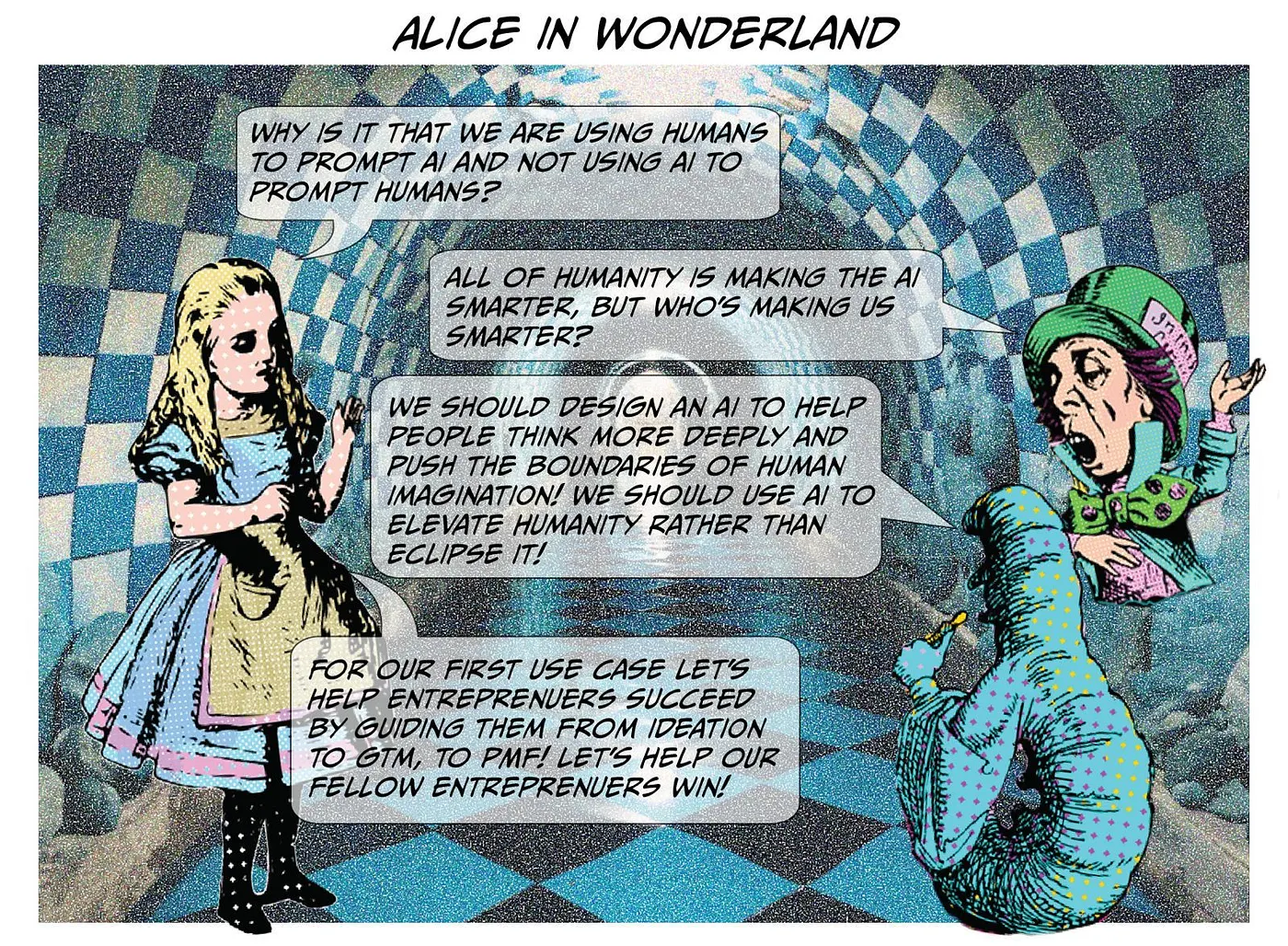
Not an AI that thinks for humans — but one that helps humans think better.
That's the category we're building:
Reflective AI: designed for augmentation, not substitution.
Technology always shapes culture, whether we mean it to or not. Every major technological inflection has ended up redefining what it meant to be human:
• The printing press transformed literacy.
• Industrialization transformed work.
• The internet transformed identity.
AI is now poised to transform cognition itself.
The question is not whether it will. The question is toward what end.
Will we use AI to offload thinking and accelerate numbness?
Or will we use it to deepen reflection, regain attention, and elevate leadership in a world drowning in noise?
That choice is not made by the models.
It's made by the builders — and by the investors who choose which visions deserve to exist.
We are currently raising a financing round to support this work.
But investment here isn't about chasing returns from the next tool or interface.
It's about deciding what kind of future you believe is worth building toward.
If this perspective resonates, we'd love to continue the conversation.
Exploring what technology should mean to humanity may be one of the most important conversations of our time.
Let's build the future thoughtfully.
Not faster.
Better.
The most valuable human capacity in the age of AI is not speed — it's judgment. As information becomes infinite, wisdom becomes scarce. As answers multiply, the quality of questions matters more. We're building Reflective AI designed to cultivate those capacities, not replace them. This may be one of those rare moments in history where the choices we make about technology determine what kind of humans we become.
Written by Stephen Klein, Founder/CEO of Curiouser.AI
Stephen Klein is Founder/CEO of Curiouser.AI — building AI to amplify human intelligence, not replace it. He teaches at Berkeley and is writing a book with Georgetown on post-automation strategy. Curiouser is community-funded on WeFunder.

