DATE
November 22, 2025
Category
AI
Reading time
4 min
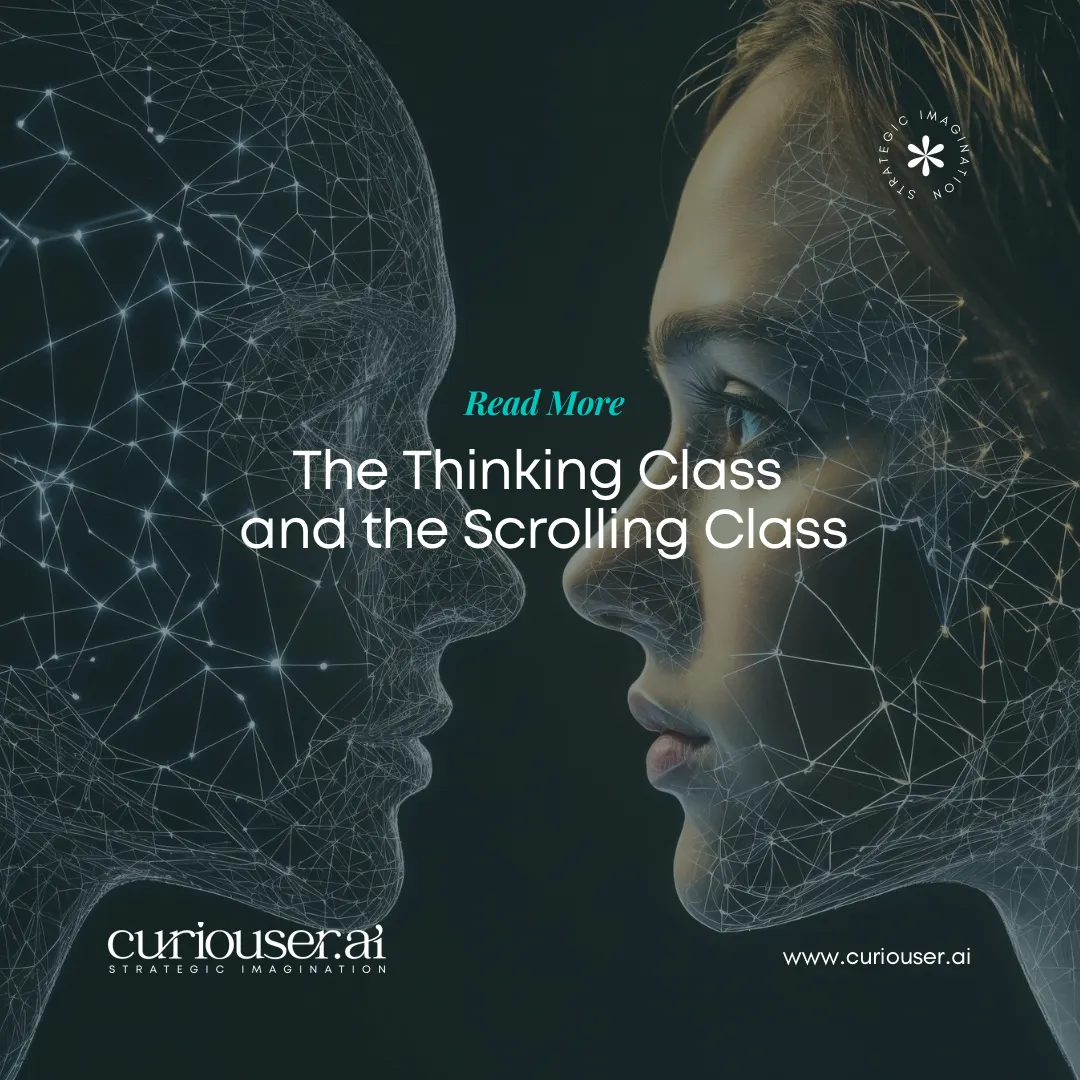
The Thinking Class and the Scrolling Class
Brené Brown just said the quiet part out loud.
And she's right.
She sits in private rooms with tech billionaires. She hears how they talk when the cameras are off and the microphones are muted — the way powerful people talk when they forget the rest of us exist.
So she asked them a simple question:
"Hey, tech billionaire, what should my kids study?"
The answer was always the same:
The Stoics. Epictetus. Marcus Aurelius. Philosophy. History.
Not coding. Not prompting. Not "AI literacy."
Philosophy. The humanities. Old ideas. Hard ideas.
So Brown finally asked the question only a truth-teller asks:
*"Which is it, dude?"*¹
Because these same people, on conference stages, in podcasts, in earnings calls, are telling us:
School is dead. Learn to prompt yourself. Just keep scrolling.
And then she delivered a line that should have set off alarm bells across the country:
**"A thinking class is emerging. They're reading philosophy and history. The rest of us? Just keep scrolling. Don't worry about the big words. They'll handle the big words for us."**¹
This is not a conspiracy theory. It's a pattern.
A pattern that's been hiding in plain sight for years.
You've heard the stories, but maybe you didn't let them sink in.
Steve Jobs didn't let his kids use iPads. Walter Isaacson wrote that every night, the Jobs family ate dinner at the kitchen table discussing books and history. "No screens allowed." No iPads. No laptops. No exceptions.²
And it's not just Jobs.
The CTO of eBay sends his kids to a Waldorf school — no screens permitted, ever. Employees from Google, Apple, Yahoo, and other tech giants do the same.
Three-quarters of students at the Waldorf School of the Peninsula have parents who work in tech.
These are the people who built the machines we can't put down.
And they're choosing something different for their children.
Something older. Something slower. Something human.
The Flynn Effect — the long-documented rise in IQ scores across the 20th century — reversed around 1975.
Reversed.
We are now losing **7 IQ points per generation.**³ Not because of genetics. Because of environment.
The environment is us. The environment is screens. The environment is speed.
If you're wondering how that trend connects to AI, the new research is even more disturbing.
A 2025 study found:
**AI usage is inversely correlated with critical thinking (r = -0.75).**⁴ The more we use it, the less we think.
This is not a subtle correlation. This is a devastating one.
And then came the most symbolic moment of all.
When ChatGPT went down for four hours in December, Sam Altman admitted he had:
"Forgotten how to work without it."
Think about that.
The man building the system that thinks for us has already outsourced his own thinking to it.
This part rarely gets talked about openly, but it's documented.
Reid Hoffman told The New Yorker that **50%+ of Silicon Valley billionaires have "apocalypse insurance."**⁵ Not metaphorically. Literally.
Bunkers. Escape plans. Citizenship in stable countries.
Peter Thiel got New Zealand citizenship after 12 days in the country. Then bought 500 acres. Then built a panic room.
Why?
Because the people building the future aren't sure they'll want to live in it.
And they've quietly prepared for the possibility that the same technologies they evangelize to the rest of us may destabilize the world they live in.
Put it all together and a chilling picture forms:
A thinking class and a scrolling class. A writing class and a prompting class.
One reads philosophy and history. One consumes content.
One practices attention. One lives inside the algorithm.
One thinks for itself. One outsources cognition.
This isn't about intelligence. This is about agency.
The question is no longer:
"Are we getting dumber?"
The question is:
"Are we already too numb to notice?"
Unplugging isn't the answer. Running to the woods isn't the answer.
The answer is reclaiming the mental muscles we've allowed technology to atrophy:
Read difficult things. Think slowly. Write your own thoughts. Stand apart from the algorithm. Do the hard, ancient, unautomatable things.
Because the people at the top already are.
And they're counting on the rest of us not noticing.
A thinking class is emerging — reading philosophy, practicing attention, reclaiming the slow hard work of thought. And a scrolling class is being told that's fine, that AI will handle the big words. The gap isn't inevitable. But it requires noticing it first. The way out isn't Luddism. It's reclaiming what makes us human.
Written by Stephen Klein, Founder/CEO of Curiouser.AI
Stephen Klein is Founder/CEO of Curiouser.AI — building AI to amplify human intelligence, not replace it. He teaches at Berkeley and is writing a book with Georgetown on post-automation strategy. Curiouser is community-funded on WeFunder.

