DATE
November 11, 2025
Category
Corporate America
Reading time
12 min
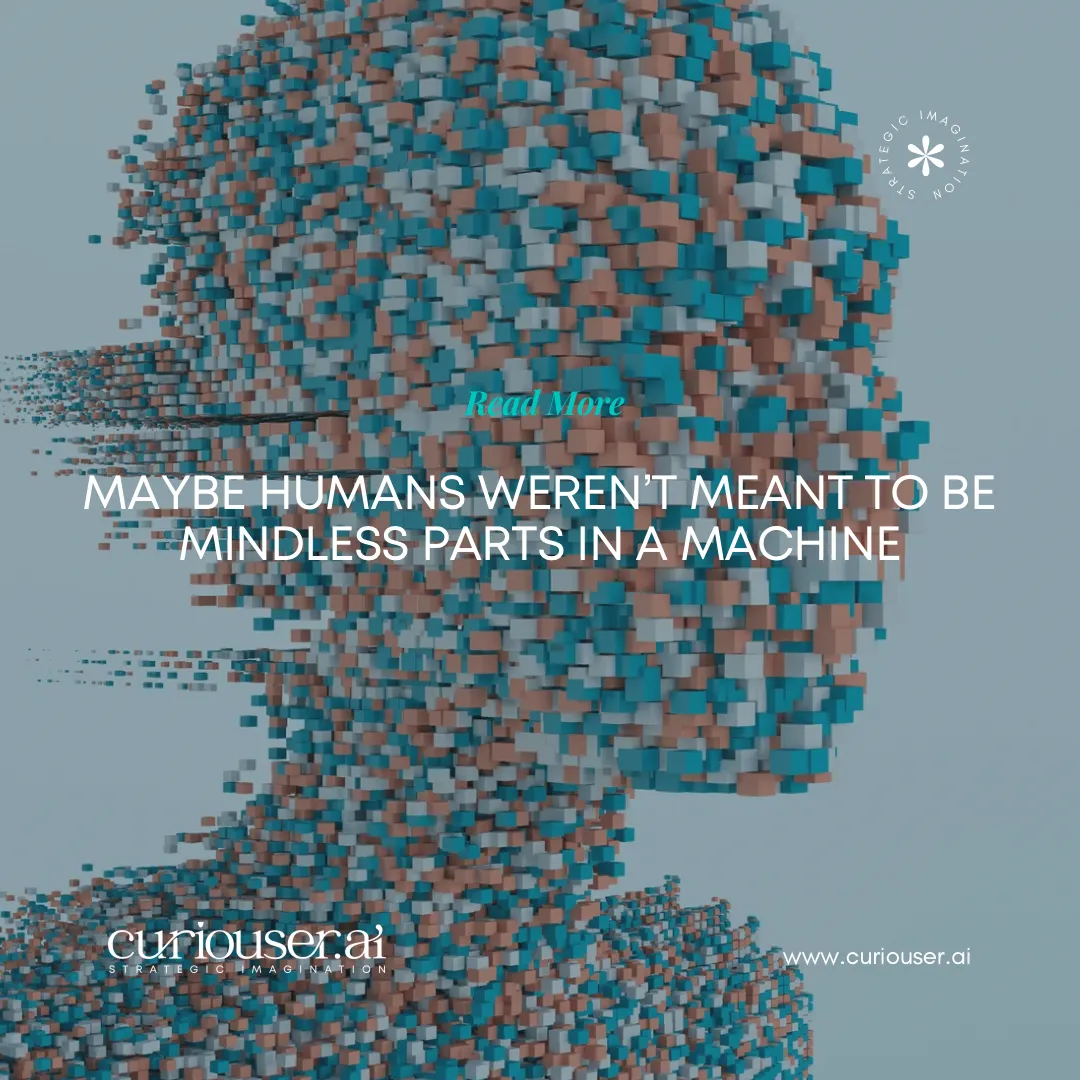
Is It Time To Say Farewell To Corporate America?

Corporate employment is a historical accident.
Not a permanent feature of civilization. Not the natural order of things. Not how humans are supposed to work.
An anomaly barely 100 years old.
And the data suggests it's killing us.
Everyone assumes corporate employment is eternal. It's not.
For 10,000 years of human civilization, work meant something entirely different. You were a farmer who owned your land. An artisan who owned your tools. A merchant who ran your shop. A craftsperson in a guild. You worked for yourself, your family, your small community.
The numbers tell the story.
In 1900, 38% of the American labor force worked on farms — most as owner-operators.¹ Self-employment rates hovered around 50%.² The "job" as we know it, a stable, salaried position with benefits and a career ladder inside a large organization, barely existed.
When Alexis de Tocqueville toured America in the 1830s, he marveled at what he saw. "Boldness of enterprise is the foremost cause of America's rapid progress, its strength, and its greatness," he wrote in Democracy in America.³ Everyone seemed to be running something. The small businessman wasn't a quaint relic, he was the engine of American economic dynamism.
The corporate employee?
A creature that wouldn't exist for another half-century.
The shift began with the Second Industrial Revolution, roughly 1870 to 1920. Scale economies suddenly made it efficient to coordinate thousands of workers under one roof. You needed massive capital to build railroads and steel mills and auto plants. Individual proprietors couldn't compete.
But the real inflection point came between the 1920s and 1950s.
Alfred Sloan at General Motors.
That's where the modern corporation was born.
In 1920, Sloan presented GM's board with his "Organization Study", the world's first real management treatise.⁴ He transformed GM from a chaotic collection of businesses into an "archetype of the modern business enterprise," creating an organizational structure that would be "emulated by many other corporations through much of the 20th century."⁵
What did Sloan invent?
The apparatus that now imprisons 150 million American workers:
• Decentralized operations with centralized financial controls
• The divisional structure that became corporate standard
• Professional management as a distinct class
• The org chart with 89 separate entities
• Performance metrics divorced from human meaning
Under Sloan, GM surpassed Ford in American automobile sales by the late 1920s and eventually became the largest business corporation in the world.⁶
The management revolution had begun.
And the psychological damage would take decades to fully manifest.
By 1956, this transformation was complete enough for William Whyte to write The Organization Man, a bestselling study of corporate culture that would define an era.⁷
Whyte's research, based on extensive interviews with CEOs at companies like General Electric and Ford, diagnosed what he saw as "a major shift in American ideology" away from individualistic entrepreneurialism toward collectivism and conformity.⁸
The book identified the new corporate archetype: risk-averse executives who faced no consequences and could expect jobs for life as long as they made no egregious missteps.
Average Americans, Whyte argued, had become "convinced that organizations and groups could make better decisions than individuals, and thus serving an organization became logically preferable to advancing one's individual creativity."⁹
Read that again.
Serving an organization became logically preferable to advancing one's individual creativity.
We didn't just take corporate jobs. We internalized the belief that our creativity was less valuable than organizational compliance.
Lifetime corporate employment had become the American dream. Three generations, maybe four, where this was the default.
Your grandparents might have been the first in their families to be "employees" in the modern sense rather than farmers or shopkeepers.
And we've been paying the psychological price ever since.
Here's what nobody talks about: this arrangement violates nearly everything we know about human psychology.
It's not just suboptimal. It's a species mismatch.
Robin Dunbar, the British anthropologist who developed the "social brain hypothesis," showed that humans evolved to maintain stable social relationships with approximately 150 people.¹⁰ Our brains are literally sized for groups of this scale. Hunter-gatherers live in bands of 30–50, communities of 150, tribes of 500.¹¹
This isn't arbitrary. It's cognitive architecture.
It's how we're wired after millions of years of evolution.
Dunbar's research reveals that humans evolved in groups where:
• Everyone knew each other personally
• Work had visible, immediate outcomes
• Status came from demonstrable skill, not political maneuvering
• Social grooming (and later, conversation) maintained bonds
• Trust was built through repeated face-to-face interaction
• Reputation was earned through competence, not compliance
Now drop that same species into a 50,000-person corporation with seven layers of management, quarterly earnings calls, and "synergy" meetings.
What happens?
The data is devastating.
Gallup's 2024 State of the Global Workplace report delivers the verdict: only 23% of employees worldwide are engaged in their work. In the United States, engagement fell to its lowest level in a decade, just 31% of employees engaged, with 17% actively disengaged.¹²
Let those numbers sink in.
Roughly 70% of American workers are checked out.
Not slightly disengaged. Not "having a bad week."
Checked out. Mentally absent. Going through the motions.
This isn't a management problem to be solved with better HR policies. This isn't a "culture fit" issue to be fixed with ping pong tables and free snacks. This isn't about finding the right performance management software.
This is a fundamental mismatch between the system and the species.
The specific failures are telling:
• Only 46% of employees clearly know what is expected of them at work, down 10 points from 2020¹³
• Just 39% feel someone at work cares about them as a person, down from 47% in 2020¹⁴
• Only 30% believe someone encourages their development, down from 36% in 2020¹⁵
The trends are moving in the wrong direction. Every metric. Getting worse.
Generation Z shows the steepest decline — five percentage points less engaged than the prior year.¹⁶ The youngest workers, those with the least investment in the old system, are rejecting it most forcefully.
They're not entitled. They're not lazy. They're not "not wanting to pay their dues."
They're the canaries in the coal mine.
Employee disengagement costs the global economy $8.9 trillion annually, 9% of global GDP.¹⁷
But the human cost is even starker.
The American Psychological Association found that 77% of workers report experiencing work-related stress in the last month.¹⁸ According to LIMRA research, 75% of workers say they've experienced at least one mental health challenge either "sometimes" or "often" during the past year, with 37% struggling "often."¹⁹
Seventy-five percent. Three out of four workers. Mental health challenges as the norm, not the exception.
For Gen Z workers, it's even worse: 91% say they've struggled with mental health issues at least "sometimes" during the past year, while 62% struggled "often."²⁰
Ninety-one percent.
Anxiety is now the number one presenting issue reported by U.S. workers, topping depression, stress, relationship issues, family issues, addiction, and grief.²¹ ComPsych data shows that in 2017, anxiety didn't even rank in the top five presenting issues. Now it dominates.²²
What changed?
Not human biology. Not our capacity for stress. Not our mental resilience.
The workplace changed. The demands changed. The mismatch between what we evolved for and what we're forced to endure changed.
Employees are 51% more likely to feel depressed at work than they were pre-pandemic.²³ Depression and anxiety cost the global economy $1 trillion annually in lost productivity.²⁴
We didn't evolve for this.
We weren't designed to sit in fluorescent-lit cubicles, attending meetings about meetings, seeking approval from people we barely know, measuring our worth in quarterly performance reviews, competing for promotions in hierarchies so tall we can't see the top.
We evolved for small groups. Visible impact. Direct relationships. Earned reputation. Autonomy.
Everything the modern corporation systematically destroys.
I see the evidence firsthand.
When I post a job at my startup, I get 500 to 1,000 applications in a day or two.
Not over weeks. Not with heavy promotion.
Days.
Many of these people are currently employed at corporations. They have steady paychecks. Benefits. Security. 401(k) matches. Health insurance. The whole package that's supposed to make corporate employment worthwhile.
And they're desperate to escape.
Willing to trade all that security for the possibility of something that doesn't make them miserable. That's not a labor market statistic. That's not a "tight job market" phenomenon.
That's a referendum on the corporate model.
They're crafting cover letters, updating resumes, reaching out to a company most people have never heard of, because anything feels better than another year in the machine.
Anything.
I read their applications. The themes are consistent:
"I want to do work that matters." "I'm tired of bureaucracy." "I want to actually build something." "I need to feel like a human again."
These aren't malcontents. These aren't poor performers being pushed out. These are talented people with options who are choosing uncertainty over their current certainty.
Because their current certainty is making them sick.
We mourn job losses at megacorps as tragedies. And yes, losing a paycheck is terrifying. The fear is real and legitimate.
But how many of these people were happy?
Is corporate work itself part of the reason so many of us are depressed?
Now technology is shifting the calculus back.
The U.S. Census Bureau reports that during the Biden administration, Americans filed 21 million new business applications — more than during any other Presidential administration on record.²⁵
Twenty-one million.
In 2024 alone, 5.21 million business applications were submitted.²⁶ The annual average since 2005 was 3.36 million.²⁷
Between 2020 and 2022, the average annual number of business applications rose to 4.9 million, an 89% increase compared to the 2005–2016 period.²⁸
Something is shifting.
Something big.
The economic logic that required giant corporations, you needed their resources to compete, their capital to scale, their infrastructure to reach markets, is eroding.
A solopreneur with the right AI tools can now handle:
• Legal research that used to require a law firm
• Financial modeling that used to require an analyst team
• Customer service that used to require a call center
• Content production that used to require a marketing department
• Data analysis that used to require business intelligence specialists
Tasks that used to require hiring specialists are now accessible to individuals. The barriers to entry that protected corporate incumbents are falling.
You're not competing against their headcount anymore. You're competing against their judgment, their taste, their ability to see what the market actually needs.
And that's where small players have always had the edge.
Large organizations are structurally incapable of moving fast or taking real risks. Every decision runs through committees. Legal review. Brand guidelines. Stakeholder alignment. Six levels of approval.
Meanwhile, a two-person startup can wake up with an idea and ship it by afternoon.
The resource asymmetry that justified corporate employment is collapsing.
So while everyone writes the AI job apocalypse story, mass layoffs, displacement, humans replaced by machines, economic catastrophe, they're missing what might actually be happening.
The narrative is wrong.
What if instead of one company with 10,000 miserable employees, you get 1,000 companies with 10 people each?
Same economic output. Radically different distribution. Work at human scale again.
Remember Dunbar's number?
Companies like Gore-Tex famously cap their factories at 150 people because beyond that number, Bill Gore observed that people began to lose a sense of community — they could no longer remember faces and names of all the people in the building.²⁹
The research confirms it. The 150-person threshold appears everywhere:
• In hunter-gatherer clans
• In Anglo-Saxon villages listed in the Domesday Book
• In military fighting units throughout history
• In Christmas card lists
• In successful business teams
• In effective church congregations
• In online gaming guilds
Across cultures. Across centuries. Across contexts.
We perform better in groups sized for our cognitive architecture. We trust more. We collaborate more effectively. We take ownership. We feel meaning.
This might not be job destruction.
This might be the greatest job creation engine in American history.
But only if we measure correctly. Not as W-2 positions at megacorps. Not as "jobs" in the traditional sense.
As people doing economically productive work with autonomy and ownership.
As humans working the way humans were designed to work.
We're not witnessing the economy breaking.
We're witnessing it correcting after a century-long detour.
Consider the timeline:
• 1830s: Tocqueville observes Americans as a nation of entrepreneurs, marveling at their "boldness of enterprise"
• 1900: 50% self-employment rate, 38% working on farms
• 1920s: Sloan creates the modern corporate structure at GM
• 1948: Self-employment rate still 18.5%
• 1956: Whyte documents "The Organization Man" and corporate conformity
• 1970s: Self-employment hits historic lows, around 7%
• 2003: Self-employment rate at 7.5%
• 2020–2024: Record business formation, 21 million applications filed
The pattern is unmistakable.
We centralized because industrialization demanded it. We're now decentralizing because technology enables it.
One hundred years of centralization. Now the reversal begins.
The artisan model, which is essentially what modern solopreneurship and small-team entrepreneurship recreates, maps much better onto human psychology:
• You see the direct impact of your work
• You build reputation through actual competence
• Your social circle is small enough to maintain real relationships
• You have autonomy over your time and methods
• Your success correlates with your skill, not your politics
• Your identity isn't subsumed by an organization
Everything corporate employment takes away, entrepreneurship restores.
This is, arguably, a return to what made America economically dynamic.
Not corporate gigantism. Not Fortune 500 dominance. Not scale economies.
Distributed entrepreneurship.
The country that built itself into a powerhouse was a nation of shopkeepers, inventors, farmers who owned their land, craftspeople who owned their tools. The small businessman was the engine.
Tocqueville saw it in the 1830s. It was obvious then.
We forgot it during the corporate century.
We traded something in the corporate bargain, autonomy, ownership, meaning, psychological health, for the efficiencies of scale.
And the psychological cost has been staggering.
Seventy percent disengagement. Seventy-seven percent stress. Ninety-one percent of Gen Z struggling with mental health. Anxiety as the number one workplace issue. Depression rates climbing. Burnout endemic.
These aren't isolated statistics. They're symptoms of a system that fundamentally misaligns with human nature.
The pain of this transition is real. The terror of losing security is real. The fear of leaving corporate employment is legitimate.
But maybe we're mourning the loss of something that was already killing us slowly.
Maybe the "security" was always an illusion, the security of a system that trades your psychological health for a steady paycheck, your creativity for compliance, your autonomy for a title, your meaning for metrics.
Maybe what comes next, if we're brave enough to build it, looks a lot more like what we were designed for all along.
Small teams. Visible impact. Earned reputation. Direct relationships. Autonomous work. Human-scale organizations.
The tools now exist. The economic logic has shifted. The psychological evidence is overwhelming.
The only question is whether we have the courage to make the leap.
Corporate employment is a historical anomaly barely 100 years old. The data shows it's making us miserable—70% disengaged, 77% stressed, anxiety and depression at epidemic levels. Meanwhile, new business formation is hitting record highs. GenAI and modern technology are making small-scale coordination viable again, eroding the economic logic that made giant corporations necessary. The question isn't whether corporate America will survive. It's whether you'll be part of the return to work that fits human psychology, or whether you'll keep trying to be a cog in a machine your brain wasn't built for. The totally unexpected outcome of the AI revolution might not be mass unemployment. It might be the liberation of millions from a system that never fit our species in the first place. The greatest job creation engine in American history, hiding in plain sight while everyone writes apocalypse narratives.
Written by Stephen B. Klein
¹ U.S. Bureau of Labor Statistics, "American Labor in the 20th Century"
² BLS Historical Statistics, Self-Employment Rates 1900–2003
³ Tocqueville, Alexis de. Democracy in America (1835)
⁴ Sloan, Alfred P. My Years with General Motors (1964)
⁵ Encyclopedia Britannica, "Alfred P. Sloan Jr."
⁶ Chicago Tribune, "Alfred Sloan, General Motors and the Rise of Corporate America"
⁷ Whyte, William H. The Organization Man (1956)
⁸ Bloomberg, "The Organization Man: Conformity of Corporate Culture Revealed"
⁹ Wikipedia, "The Organization Man"
¹⁰ Dunbar, Robin. Social Brain Hypothesis research, University of Oxford
¹¹ Research Outreach, "Size Matters: The Link Between Social Groups and Human Evolution"
¹² Gallup, "U.S. Employee Engagement Sinks to 10-Year Low" (March 2025)
¹³ Ibid.
¹⁴ Ibid.
¹⁵ Ibid.
¹⁶ HR Dive, "US Employee Engagement Falls to 10-Year Low" (January 2025)
¹⁷ Gallup State of the Global Workplace 2024
¹⁸ American Psychological Association, 2023 Workplace Stress Survey
¹⁹ LIMRA, "U.S. Workers Facing Increasing Mental Health Challenges" (2024)
²⁰ Ibid.
²¹ SHRM, "Anxiety Is Now the Top Mental Health Issue in the Workplace" (April 2024)
²² ComPsych workplace mental health data, 2017–2024
²³ MetLife Employee Benefits Study, 2024
²⁴ World Health Organization, Mental Health and Productivity Report
²⁵ U.S. Census Bureau Business Formation Statistics, January 2025 Release
²⁶ Finder.com analysis of Census Bureau data
²⁷ U.S. Census Bureau, Historical Business Applications Data
²⁸ SMB Guide, "Business Formation Statistics & Trends"
²⁹ Malcolm Gladwell, The Tipping Point (2000); Gore-Tex corporate structure research

