DATE
January 2, 2026
Category
Entrepreneurship
Reading time
3 min
A New Year's Resolution for the Age of Independent Work

Before the year turns, it's worth pausing on a simple but underappreciated fact.
There are going to be a lot more of us.
In the United States alone, over five million new businesses are started each year. That level of business formation is nearly double the pre-2020 norm and has remained persistently elevated even as other parts of the economy slow or retrench.
This is not a venture capital boom. This is not a startup bubble. And it is not being driven by optimism alone.
It is structural.
Millions of people are starting businesses because traditional employment paths have become less stable, less predictable, and in many cases less available. Layoffs have become routine. Career ladders have shortened or disappeared. Credentials no longer guarantee opportunity.
So, people adapt.
We find a way.
We built this country.
We become independent consultants. Solo founders. First-time business owners. Professionals selling their expertise directly because there is no longer a clear alternative.
What often goes unsaid is that most of these businesses are being started alone.
No built-in network. No institutional backing. No safety net for major early mistakes.
And the odds are not particularly forgiving.
Roughly one in five new businesses fails within the first year. About half fail within five years. The most common causes are not laziness or lack of intelligence, but poor early decisions made with limited information, limited context, and limited support.
That is the reality facing millions of new builders right now.
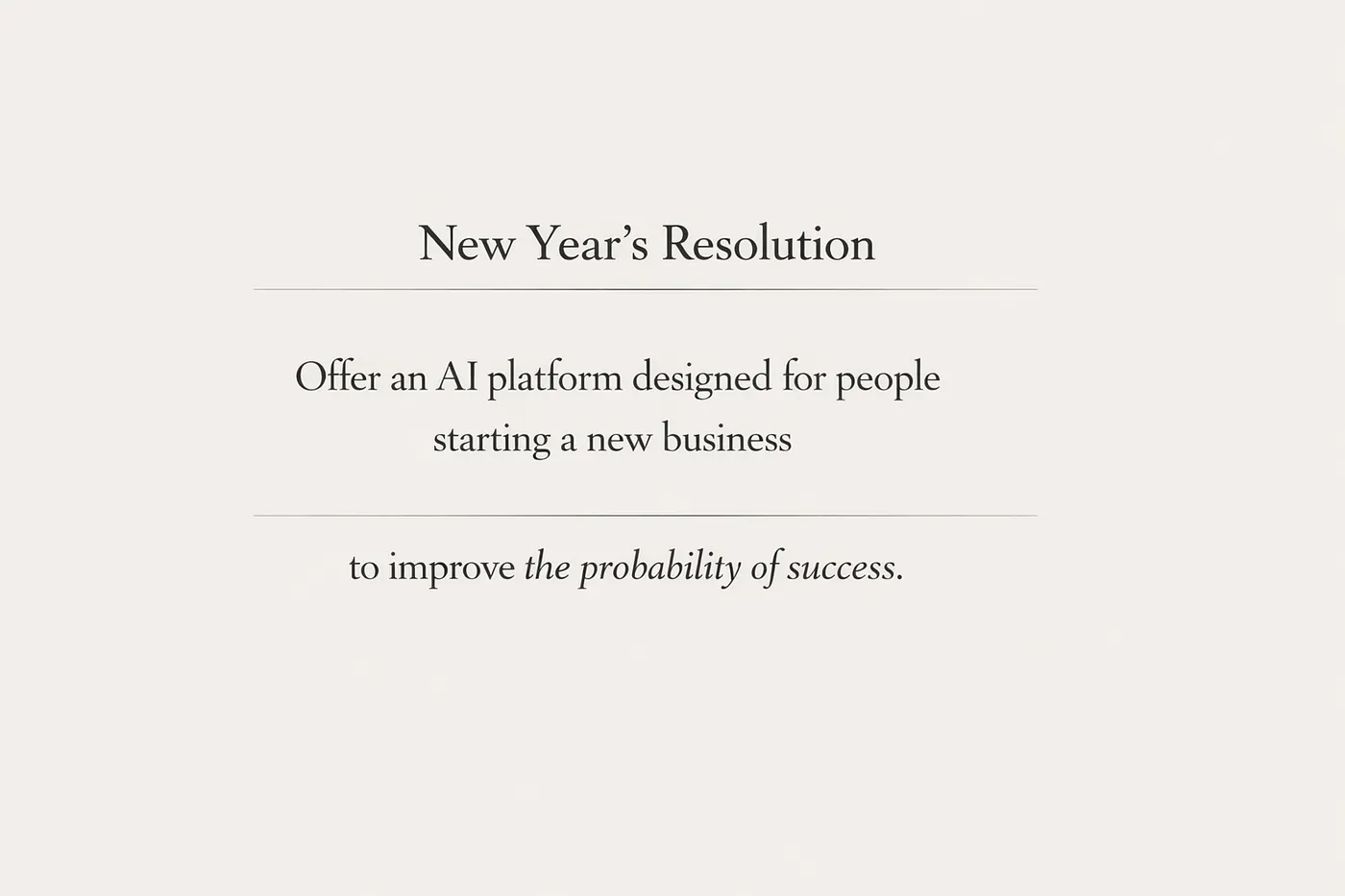
Which leads to my New Year's resolution.
To help create an AI platform designed specifically for people starting businesses on their own, with a single goal: to improve the probability of success.
Not by making people faster. Not by automating judgment. Not by replacing human thinking with templates or shortcuts.
But by helping people think better at the moments that matter most.
Early-stage decisions compound. Some mistakes are recoverable. Others are not. The difference between the two is often judgment, timing, and perspective — not effort.
If millions of people are going to build independently, then the role of technology needs to be reconsidered.
This becomes less about productivity tools and more about responsibility.
How do we reduce avoidable failures? How do we help people see around corners? How do we provide context when experience is thin and stakes are high?
Even a small improvement in outcomes, applied at this scale, would matter.
Better businesses. More resilient communities. More dignity in how people earn a living.
If this is the direction the economy is moving, then taking care of each other is not a slogan. It's a necessity.
That is the work ahead.
Five million new businesses start each year in the U.S. alone — most of them alone, with no safety net. Technology's role in this moment isn't productivity. It's responsibility. If we can help people think better at the moments that matter most, even small improvements in outcomes compound into something that matters for communities, for dignity, and for the economy.
Written by Stephen Klein, Founder/CEO of Curiouser.AI
Stephen Klein is Founder/CEO of Curiouser.AI — building AI to amplify human intelligence, not replace it. He teaches at Berkeley and is writing a book with Georgetown on post-automation strategy. Curiouser is community-funded on WeFunder.

