DATE
November 2, 2025
Category
Philosophy
Reading time
9 min
A Different Kind of Courage (Inspired by Simone Weil)

I've been re-reading Simone Weil recently, one of the few women philosophers whose work has endured in a field dominated by men.
In large part because so much of what's going on in technology these days is so disturbing, and quite frankly, unnecessary.
Weil wasn't an academic philosopher safe in her ivory tower. She was a brilliant École Normale Supérieure graduate who left teaching to work in factories. Not to study workers from a distance. Not to write theoretical papers about labor. To be one.
She worked at Renault and other plants, operating heavy machinery despite chronic headaches and frail health. Her hands blistered. Her body broke down. She experienced firsthand what she called "affliction" — suffering that doesn't just hurt the body but degrades human dignity itself.
When the Spanish Civil War broke out, she joined the Republican forces despite being nearly blind and physically unfit for combat. When France fell to the Nazis, she eventually made her way to London and worked for the French Resistance while refusing to eat more than the rations available to people in occupied France. This decision, combined with tuberculosis, contributed to her early death at 34 in 1943.
Simone Weil lived 34 years and changed philosophy forever.
Not because she was the smartest person in the room (though she was). Because she had the courage to live according to her convictions.
Here's what strikes me as I watch the AI industry today:
We have an over-abundance of intelligence.
We have mind-boggling quantities of wealth.
There isn't a problem we couldn't solve if we tried. Not one.
We have more computing power than any civilization in history.
We have models that can process billions of parameters.
We have enough capital to fund almost any moonshot.
We have brilliant people everywhere you look.
And yet.
What we're missing is courage.
There isn't much of it to be found.
But we don't admit it. Even that would take courage.
Instead, we confuse courage with other things — power and wealth, mostly — when those things may represent the opposite of courage. A way to hide and stay safe behind an invisible wall everyone pretends is real.
We automate away human dignity.
(We treat people like shit)
We're not asking, "How can we make humans more human?" We're asking, "How can we eliminate the human from the loop?" We measure success by how many people we can replace, not by how much human potential we can unlock.
We prioritize quantity over quality.
(We have become average)
Everything is optimized for scale. More content, more output, more productivity. We've built systems that generate infinite mediocrity and call it progress. We're drowning in AI-generated slop that nobody asked for, and nobody wants to read.
We emphasize speed over thought.
(We often take the easy way out)
We want summaries instead of reading. Generators instead of writing. Agents instead of thinking. We're building tools to help us avoid paying attention to anything difficult or time-consuming. And we wonder why everything feels hollow.
This isn't because the technology is bad. The technology is remarkably capable.
It's because we lack the courage to ask: Intelligence for what? Toward what end? In service of what vision of human flourishing?
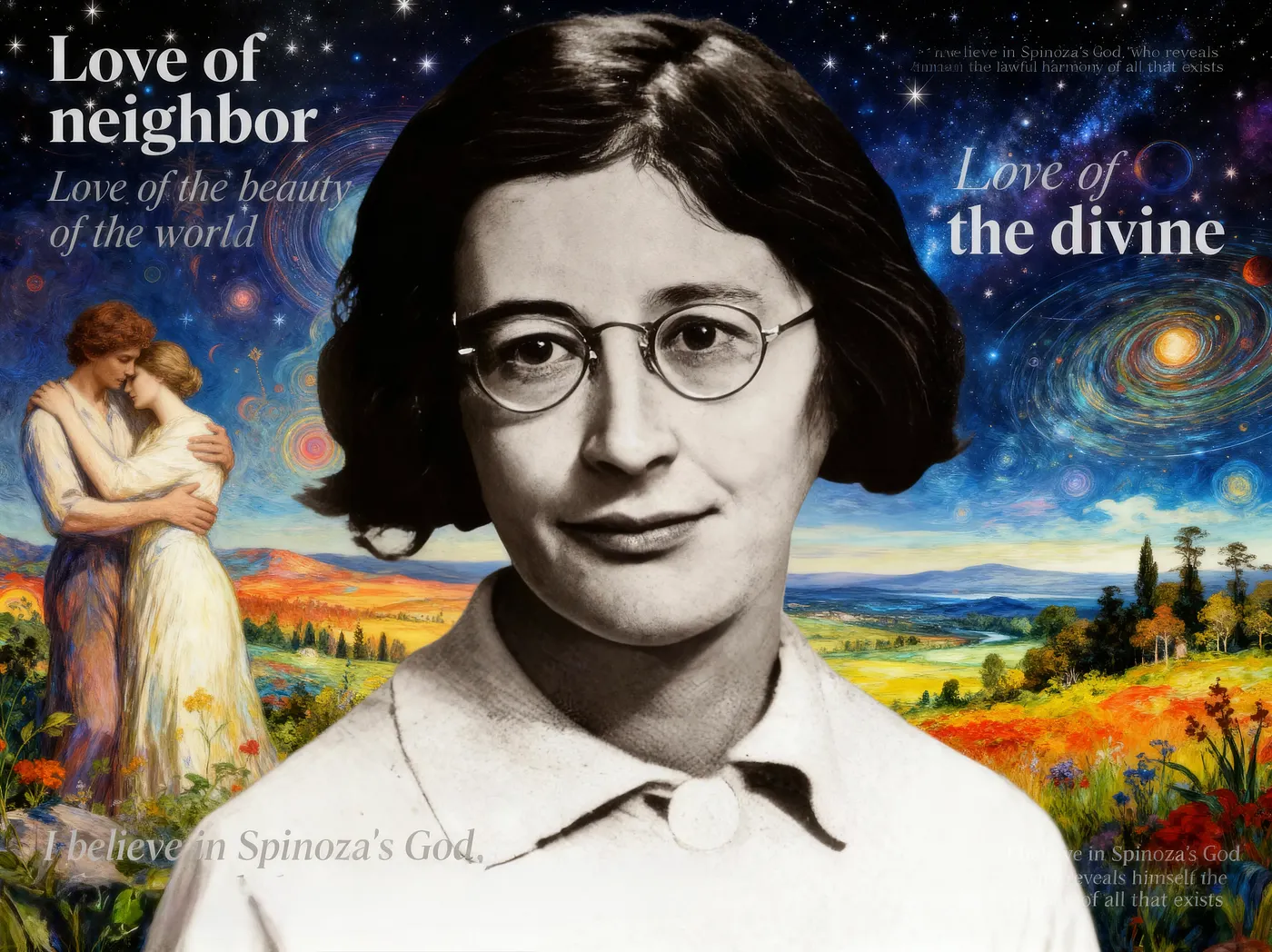
Weil wrote about three forms of love that constitute a complete human life:
She was convinced that if we adhered to all three, then God would flow through us.
Her God was more like Spinoza or Einstein's God. Nature and the fabric of the universe itself. The transcendent reality that flows through all things when we're brave enough to pay attention to it.
Einstein once said, "I believe in Spinoza's God, who reveals himself in the lawful harmony of all that exists." This was Weil's God too.
Love of neighbor means genuine attention to the suffering and dignity of other human beings. Not as data points. Not as users or monthly active users or customer acquisition costs. As people.
As fellow vessels of the same reality that flows through you.
This is why Weil worked in factories. She couldn't write about the dignity of labor from a comfortable distance. She had to experience the affliction firsthand. She had to know what it meant to be treated as a thing rather than a person.
Most of what we're building treats people as problems to be optimized away. Friction to be eliminated. Costs to be reduced.
We're not asking, "How does this honor human dignity?" We're asking, "How does this scale?"
Love of the beauty of the world means presence to the actual reality in front of you. The texture of existence.
Not the optimized version. Not the AI-generated summary of the version.
This is attention to nature, to the physical world, to what Einstein called the "lawful harmony" of existence itself.
We're building tools that keep us from experiencing this beauty. Every layer of mediation we add — every summary, every agent, every automation — puts us one step further from direct contact with reality.
Love of the divine means orientation toward something beyond your ego. Beyond your quarterly targets. Beyond your five-year plan.
The transcendent reality that claims us whether we acknowledge it or not.
This requires surrendering the illusion of total control. It means you might get filled with something that disrupts your business plan, challenges your assumptions, demands you change course.
The AI industry right now is built on the opposite premise: total control, complete predictability, perfect optimization.
We want to make everything measurable and therefore manageable.
But what if the most important things can't be managed?
What if love of neighbor, love of beauty, and love of transcendent reality require exactly the human presence we're trying to automate away?
Weil called attention "the rarest and purest form of generosity."
Prescient, right?
Not intelligence. Not innovation. Not disruption.
Attention.
We're living through the greatest abundance of intelligence in human history. And we're using it to engineer attention OUT of human life.
Think about what we're building:
• Summary tools that keep us from reading actual texts
• Generation tools that keep us from writing our own thoughts
• Agent tools that keep us from engaging with actual work
• Automation that eliminates every opportunity for human presence
All that intelligence. All that capability. All of it moving us further from the one thing Weil says we most need: the capacity for genuine attention.
This is the crisis. Not that we lack intelligence. That we lack the courage to use our intelligence in service of attention rather than in service of its elimination.
Weil showed us what courage looks like.
She was so brave.
Not brave in the sense of taking physical risks (though she did that too).
Brave in the sense of living with complete integrity between her convictions and her actions.
She didn't write about affliction from a university office. She experienced it in factories.
She didn't theorize about solidarity. She starved herself in solidarity with people she would never meet.
She didn't speculate about transcendence. She oriented her entire life toward it, even when it cost her everything.
This kind of moral seriousness is almost embarrassing in 2025.
We prefer intelligence without courage. Opinions without sacrifice. Disruption without consequences.
We want to change the world without changing ourselves.
But Weil shows us there's no other way. If you want to understand affliction, you must experience it. If you want to love your neighbor, you must be present to their suffering. If you want to access transcendent reality, you must surrender control.
You must pay attention.
And that requires courage.
While I've read many philosophers over the years, each in a way a friend through time, Simone is extraordinary in her prescience and relevance to today.
She was the very definition of authenticity and didn't know the meaning of cowardice.
That combination is what made her work endure. Not just the brilliance of her ideas, but the courage to live them fully. To pay the price her convictions demanded.
Most of us — myself included — choose comfort over courage far more often than we'd like to admit.
We know what we should build, but we build what's fundable instead.
We know what we should say, but we say what's safe instead.
We know where we should direct our attention, but we let it be captured by whatever's easiest instead.
Weil didn't do any of that. She lived 34 years with more integrity than most of us will achieve in 80.
The question isn't whether we can match her courage. Most of us can't and won't.
The question is: Can we at least move in that direction? Can we build one thing that requires real courage? Can we pay attention to one thing that matters, even when distraction would be more comfortable?
Can we admit that the bottleneck isn't intelligence, but courage?
Even that admission would be a start.
The technology we need isn't smarter. It's braver.
We need tools built by people who have the courage to ask, "What serves human dignity?" before they ask, "What scales?"
We need systems designed by people brave enough to increase human attention rather than eliminate it.
We need companies led by people with the courage to say no to investors, no to bad uses of technology, no to automation that degrades rather than elevates.
We're watching something remarkable happen in real-time: the gap between the AI narrative and AI reality is becoming impossible to ignore.
Enterprise AI pilots are failing at 80%+ rates. Adoption is declining, not accelerating. Companies are quietly pulling back from AI-first strategies.
Not because the technology isn't intelligent. It is. But because we've been building the wrong thing for the wrong reasons with the wrong values.
We've been building automation when the market wants augmentation.
We've been building replacement when humans need enhancement.
We've been building tools to eliminate attention when what we crave is the capacity to pay better attention.
The courage to acknowledge this — to admit that maybe the whole direction was wrong — that's what's missing.
Simone Weil would recognize this moment. She lived through the collapse of narratives too. She watched ideologies she'd believed in reveal their emptiness. She saw the gap between what people said and what they did.
Her response wasn't cynicism. It was deeper commitment to truth, to attention, to the three loves that constitute a complete human life.
That's the example we need now.
Not more intelligence. More courage.
Not better AI. Better humans.
Not faster automation. Deeper attention.
Simone Weil died at 34, far from home, from a combination of tuberculosis and self-imposed starvation.
Some people call that tragic. Others call it noble.
I think it was simply consistent. She lived and died according to her convictions. She paid attention to what mattered — her neighbors, the beauty of the world, the transcendent reality flowing through all things — and she let that attention guide her life, even unto death.
Most of us won't go that far. Shouldn't go that far.
But we can go further than we're going now.
We can build one thing that requires real courage.
We can pay attention to one thing that matters.
We can say one truth that's expensive to say.
We can choose dignity over efficiency, meaning over scale, attention over automation.
The courage to do that, to really do it, not just talk about it, that's what changes the world.
Simone Weil lived 34 years with more integrity than most achieve in 80. She worked in factories to experience affliction firsthand, joined the Spanish Civil War despite being unfit, and starved herself in solidarity with occupied France. She showed us that courage isn't about intelligence or power—it's about living with complete integrity between convictions and actions. As the AI industry builds tools to eliminate attention, automate dignity, and optimize away humanity, we're missing what Weil called "the rarest and purest form of generosity": attention. The technology we need isn't smarter—it's braver. We need tools built by people who ask "What serves human dignity?" before "What scales?" The bottleneck isn't intelligence. It's courage.
Written by Stephen B. Klein
1 Simone Weil, "Reflections on the Right Use of School Studies with a View to the Love of God" in Waiting for God, translated by Emma Craufurd (New York: Harper & Row, 1951). Originally published posthumously in French as Attente de Dieu (1950).
• Gravity and Grace (La Pesanteur et la grâce, 1947) — Posthumous collection of her notebooks on spiritual and philosophical themes
• The Need for Roots (L'Enracinement, 1949) — Her final work, written for the French Resistance, on rebuilding France after liberation
• Oppression and Liberty (Oppression et Liberté, 1955) — Essays on social and political philosophy
• Lectures on Philosophy — Her lectures from 1933–34, transcribed by a student
• First and Last Notebooks — Personal notebooks covering 1940–42
Weil's factory journal and letters from this period provide raw documentation of her year working in factories and remain among the most powerful firsthand accounts of industrial labor's effects on human dignity.
Einstein's conception of God, which he explicitly linked to Spinoza, rejected the notion of a personal deity who intervenes in human affairs. Instead, he saw divinity as the rational structure and lawful harmony of the universe itself — what he called "the cosmic religious feeling." This aligns closely with Weil's understanding of the transcendent as something immanent in nature and accessible through attention rather than dogma.

